Why is Chemistry So Hard??
Chemistry is one of the most challenging subjects, especially in Canadian high schools. Many students struggle to understand major chemistry concepts. This is all because it requires a completely different way of studying.
You have to memorize core concepts, understand invisible processes, apply logic, juggle multiple learning styles, recognize patterns, solve problems, and memorize a bunch of rules that often contradict each other, all at once.
So how do you master it?
This blog is the answer to that very question. Read more to learn what makes chemistry hard and some tips that can help you master it like a pro. By the end, you will also discover how an effective tutor can help you do that.
Why Do So Many Students Struggle with Chemistry?
Why is Chemistry so hard? Why do the concepts feel abstract, and why does Chemistry feel impossible??
We have heard this question countless times from our students. However, it's not the subject that's impossible; it's the students who are molecularly illiterate. To actually understand chemistry, you need a different kind of thinking.
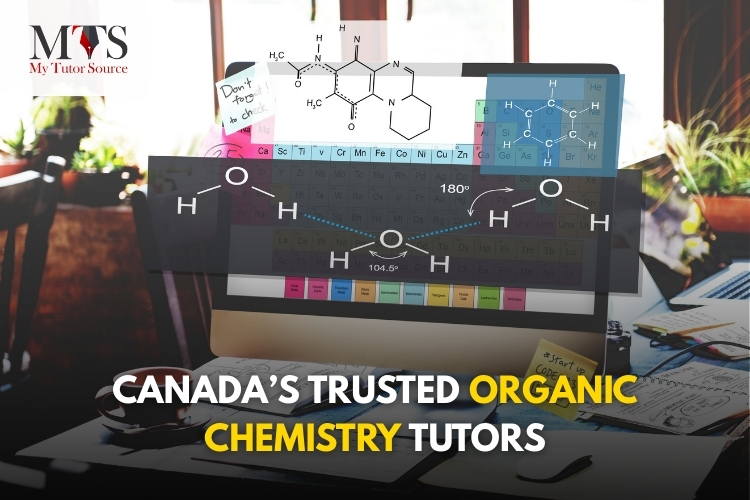
For example, when a chemist looks at a glass of water, they don’t just see “water.” They see H₂O molecules, hydrogen bonds forming and breaking, and they can sense polarity and cohesion. Most students? They see only a clear liquid in a cup.
The gap here is visibility. This visibility is what makes most students feel that the subject is impossible. This also leads them to focus more on memorization and fall behind in practicing core concepts and reactions.
Moreover, some topics in Chemistry make up the basics. They include moles, states of matter, and IUPAC families. Some fail to develop expertise in basic concepts and later struggle with chemistry.
Below, we have compiled a list of reasons why so many students in Canada struggle with chemistry today.
- Difficulty in getting expertise in abstract concepts. For instance, molecular structure, quantum theory, and orbital notation. These processes can’t be seen and require high-level visualization skills to understand them.
- Students struggle with math-heavy calculations (moles, equilibrium constants, electrochemical cell notation) because solving them requires conceptual clarity, not just rote learning.
- Although memorization alone is not enough, students are still required to learn the periodic table, functional groups, reaction types, and related concepts.
- Chemistry topics are interconnected. Failing to understand the basics of one topic can make you struggle with the topic that follows.
- The high-stakes exams need proper attention, such as the SCH4U final exam, IB Chemistry HL, AP Chemistry, and the MCAT.
Tips to Master Chemistry for an A Grade
- Instead of rereading notes again and again, try practicing the problems and reactions.
- First, try to understand and teach the concept to yourself before memorizing.
- Communicate your hardest topic to the tutor so that they can explain it first before moving on to the next.
- Use the active recall method; it works best for new concepts. Read your notes twice, close them, and try to recall everything.
- Try past exam questions so that you will have an idea of how a concept will be assessed in exams.
- Use My Tutor Source provided flashcards, quizzes, and notes for quick revision.

The Hardest Chemistry Topics and How to Handle Them
Once you get started with chemistry, many topics may feel like a mess. Here's what they are and what actually helps.
Stoichiometry
Stoichiometry is the basis for Grade 11 students in Ontario's SCH3U. The important step is learning to think in “mole ratios” rather than just following simple formula steps. Figure out every conversion slowly, write every unit, and practice with real-time
exam questions, until you understand every logic.
Organic Chemistry
This topic is known to give students the toughest time. There are many functional groups, naming rules, and reaction types that worry many students in SCH4U and IB Chem HL. Focus on why reactions occur and what concepts are behind them, rather than just memorizing products.
Electrochemistry
Topics like galvanic cells, electrolytic cells, standard reduction potentials, etc., confuse students because they involve chemical terms, diagrammatic representations, and maths.
The trick is always to understand what gets oxidized and what gets reduced. This helps understand these concepts better.
Chemical Equilibrium (Le Chatelier's Principle)
You should practice by conversing with yourself: "If I stress this system, which direction must it shift to relieve that stress?" This way, students memorize easily after understanding the logic behind it.
Gas Laws and Thermochemistry
Thermochemistry is a math-heavy topic, and one can easily grasp it when it makes factual sense.
The Easiest Solution to Mastering Chemistry - MTS
Understanding concepts is the first step towards getting a good knowledge of this subject. However, it is only possible under the right guidance.
My Tutor Source’s qualified online chemistry tutors are the best choice for students struggling with chemistry.
Tutors for Exact Curriculum
Our tutors have a complete understanding of Canadian curriculum requirements. Before your session, you are matched with the most suitable tutor. Need a tutor for SCH4U in Ontario, Chemistry 30 in Alberta, Chemistry 12 in BC? We have them all.
Everything Is Built Around The Way You Learn
In a classroom, a teacher uses a combined method of teaching specialized for all students. However, a tutor provides personalized instruction. If you are struggling with a specific topic, our tutors will start with that topic first. If you feel messed up with the basics, they will start by clearing them out first.
Available Across All of Canada
MTS operated totally online and is a globally recognized platform. Students in
Toronto,
Vancouver,
Calgary,
Halifax, and every city and town in Canada can have access to a wide range of qualified chemistry tutors.
Chemistry Curriculum in Canada by Province
Each province in Canada has a different syllabus outline for chemistry. Students who get to know what the syllabus fully expects tend to choose the curriculum and perform better.
Ontario
Course Code | Grade | Level | Key Topics Covered |
SNC1D / SNC1P | Grade 9 | Academic / Applied | Matter & Chemical Change basics |
SNC2D / SNC2P | Grade 10 | Academic / Applied | Chemical Reactions, Acids & Bases |
SCH3U | Grade 11 | University Prep | Atomic Structure, Bonding, Stoichiometry, Gas Laws, Solutions |
SCH3C | Grade 11 | College Prep | Practical chemistry applications |
SCH4U | Grade 12 | University Prep | Organic Chemistry, Electrochemistry, Equilibrium, Rates of Reaction |
SCH4C | Grade 12 | College Prep | Consumer chemistry, applied topics |
British Columbia
Course | Grade | Key Topics |
Chemistry 11 | Grade 11 | Atomic Theory, Chemical Bonding, Organic Chemistry basics, Solution Chemistry |
Chemistry 12 | Grade 12 | Reaction Kinetics, Equilibrium, Solubility, Acids/Bases, Electrochemistry, Organic Chemistry |
Alberta
Course | Grade | Key Topics |
Science 10 | Grade 10 | Chemistry foundations |
Chemistry 20 | Grade 11 | Chemical Bonding, Stoichiometry, Gases, Solutions |
Chemistry 30 | Grade 12 | Thermochemistry, Electrochemistry, Equilibrium, Organic Chemistry |
Alberta Diploma Exam | Grade 12 | Worth 30% of the final grade |
Quebec
Quebec students follow the MELS curriculum. Secondary V Chemistry is required for CEGEP science programs. CEGEP students complete the 202 series (General Chemistry, Chemistry of Solutions, Organic Chemistry) before university.
Other Provinces
Province | Key Chemistry Courses |
| Chemistry 40S (Senior 4) |
Saskatchewan | Chemistry 30 |
Nova Scotia | Chemistry 11, Chemistry 12 |
| Chemistry 122 |
PEI | Chemistry 521A / 521B |
How to Get Started with a Chemistry Tutor at MTS
Fill out the Tuition Request Form
Free meet the tutor
You will be contacted by our admin and scheduled for a 20- to 30-minute free trial.
Enjoy your session
Once you meet the chemistry tutor and are satisfied, you can proceed with the payment.
FAQs
How much does a chemistry tutor cost in Canada?
A chemistry tutor costs between $25 and $60 per hour. At MTS, you can get affordable chemistry tutors and discounts as well.
Can I get chemistry tutoring online in Canada?
Yes. My Tutor Source is an all-in-one personalized tutoring platform. It has an advanced AI-powered LMS and app with the best tutoring features.
What Topics Can a Chemistry Tutor at MTS Help You With?
A chemistry tutor at My Tutor Source (MTS) can help you with a wide range of topics spanning high school to university-level chemistry. They cover every topic in the Canadian Chemistry curriculum, including the hardest ones (Stoichiometry, Organic Chemistry, etc.).
Find Top Tutors in Your Area

.jpg)

.png)